Original generic equipment illustration. Housings and dimensions are illustrative; readings follow the declared model.
Identify the components
Resistance meter
Display follows the same numerical model as the live reading below.
COM and VΩ inputs
Black common lead and red resistance lead across a fictional isolated component.
Relative compensation
Subtracts a known fixed lead contribution in the model.
Meter reading1.3 Ω
Known component1 Ω
THE RELATIONSHIPRdisplay = Rcomponent + Rleads
Your experiment
Change one thing.
Make a prediction, adjust a control, then compare the result.
Range: 0.1–10. Type a precise value or use the slider.
Range: 0–2. Type a precise value or use the slider.
Keep your experiment.
Save controls, drawing view and your explanation on this browser. Lesson progress stays separate.
02 / THINK IT THROUGH
Why might a meter show more resistance than the component actually has?
This draft is unsaved. Save explanation to keep it with the current controls on this browser.
Model assumptions & limitations
Fictional isolated component; known constant lead resistance, no contact error or instrument uncertainty. This is not a procedure for testing live equipment.
Educational model only. Displayed values are rounded; calculations use unrounded values. Interactions do not change lesson completion. Your explanation remains in this open page unless you explicitly save it. Reset clears current controls and the draft; deleting a saved copy is a separate action.
Original drawings informed by the sources below. Source content was retrieved on 2026-11-21; a reference is not professional approval or permission to reuse its artwork.
Supports: COM/VΩ lead roles, isolated component measurement and relative lead compensation.
Limits: Real readings also depend on contact resistance, parallel paths and instrument uncertainty. The teaching instrument is generic.
REAL-WORLD CONTEXT
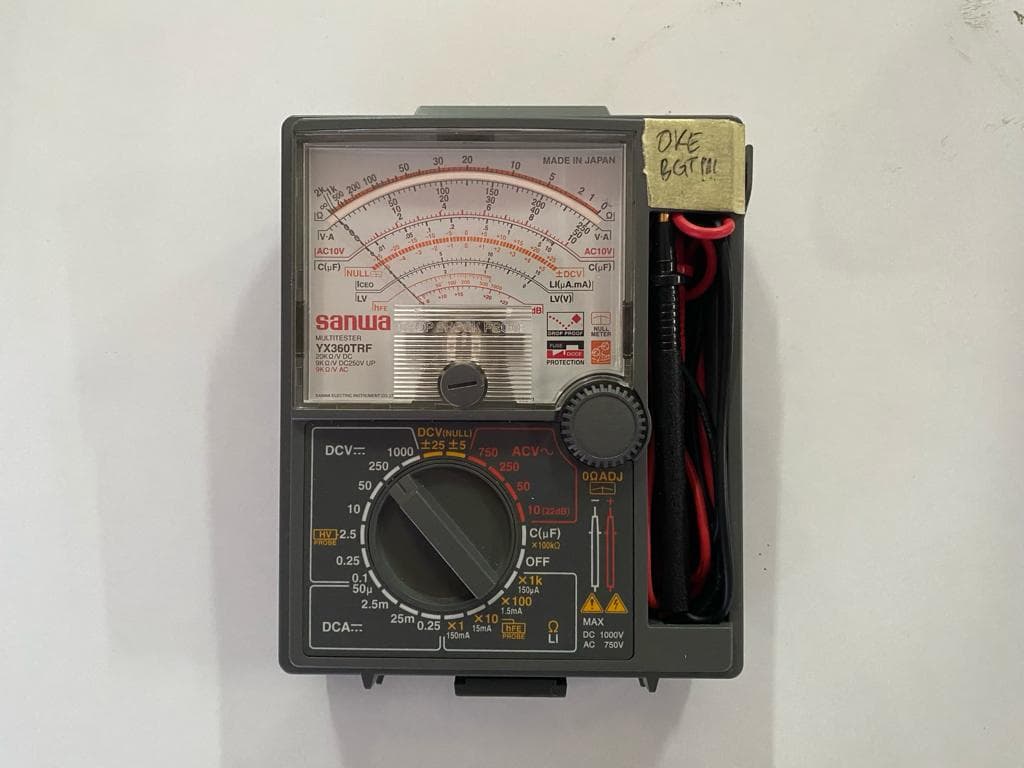
A real analog multimeter.
This authentic photograph shows an analog instrument. The interactive illustration above uses a generic digital display. The photo is context, not a validated setup for this exercise.